
Marine Inverter Sizing for Silent Power at Anchor
By Doug Thompson
When you anchor in a remote cove, the morning should sound like lapping waves against the hull and the cry of a seagull. Then the generator kicks on to brew the coffee, and the cove belongs to the engine.
It does not have to go that way. Marine inverter sizing — matching an inverter and a battery bank to the loads you actually run — buys back the quiet. An inverter draws DC power from the batteries onboard and turns it into AC power, the same current that feeds the outlets at home. The DC side charges from the generator, the boat’s engine, or solar panels.
Subscribe Here For More Boating Content
What a Marine Inverter Actually Does
An inverter and a lithium-ion battery combination solves the anchorage problem directly: it moves the household loads off the generator and onto the bank.
“A DC-to-AC power inverter is a key component in creating a more enjoyable and self-sufficient cruising experience,” says Matt Elsner, senior director of product management at the Navico Group, the parent company of ProMariner, a leading inverter manufacturer. “By enabling the use of everyday household appliances directly from onboard batteries, inverters reduce reliance on generators—minimizing noise, fuel consumption, and exhaust. The result is a quieter, more relaxed onboard environment, allowing boaters to extend their time at anchor while maintaining the comforts of home.”
Also Read
Jeanneau TH38 Review: An Outboard Power Cat for the Weekend
Jeanneau TH38: What a Difference a Dayboat Makes Jeanneau's latest twin-hull series opens the door for extended fun. By Steve...
Better components made the integrated approach popular. Lithium iron phosphate (LiFePO4) batteries store energy exceptionally well, and solar panels convert more of what hits them, feeding a constant trickle charge into the bank whenever the sun is out.
“ProMariner has focused on refining inverter technology to better meet the evolving needs of modern boaters,” Elsner says. “Key advancements include improved energy efficiency to maximize battery life, enhanced power handling for more demanding onboard loads, and increasingly compact designs that simplify installation in space-constrained engine rooms or utility areas.”
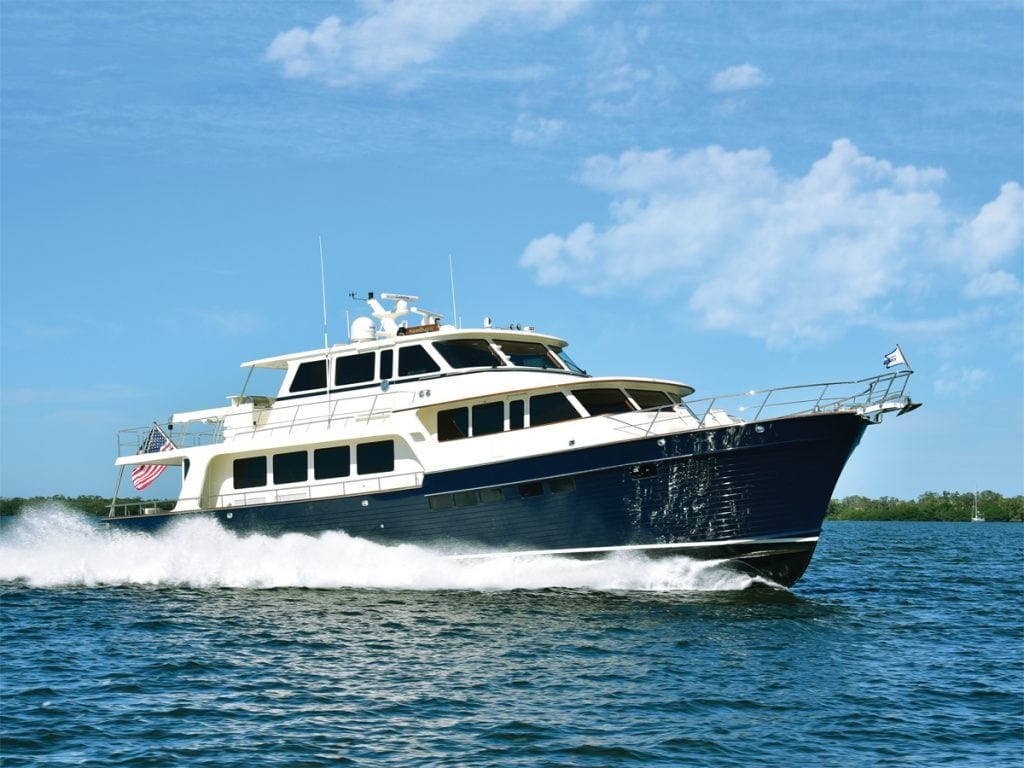
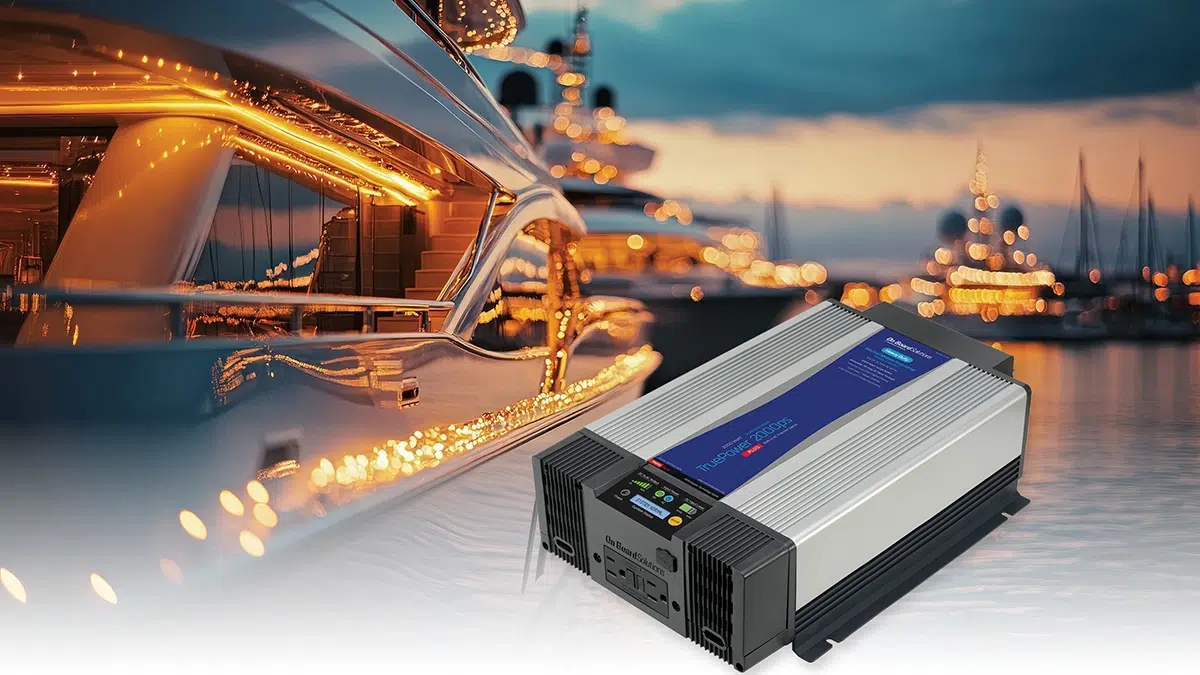
For a 50-foot cruising vessel accommodating up to six guests, the ProMariner TruePower Plus 2000PS makes a well-balanced, versatile solution. The model carries ample capacity for common onboard appliances and personal electronics, even with several devices running at once. Paired with an appropriately sized battery bank, it delivers dependable, quiet power that lifts onboard comfort without constant generator use.
Also Read:
Jeanneau TH38 Review: An Outboard Power Cat for the Weekend
Jeanneau TH38: What a Difference a Dayboat Makes Jeanneau's latest twin-hull series opens the door for extended fun....
Why Lithium Changed the Math
Improvements in lithium-ion technology reshaped what a battery bank can deliver. Lead acid holds up best when it stays above 50 percent state of charge, which protects cycle life but leaves half the nameplate capacity on the shelf. LiFePO4 typically supports a much deeper usable discharge — often 80 to 90 percent, depending on the specifications and the battery management system. (Read about battery charger installation.)
That difference yields nearly twice the usable power from a much lighter battery. Lithium also accepts a charge far faster than lead acid, which matters when a generator run or an engine transit has to refill the bank before the next stop.
One caveat governs the whole upgrade: confirm the inverter you buy handles lithium chemistry. Not every unit does, and the charging profile is not interchangeable.
How Do You Size a Marine Inverter?
Start with the loads, not the hardware. Add up the wattage draw of every AC-powered appliance and electronic device you might run at the same time, then allow room for what you will add later.
Here is where owners get it wrong. Suppose the total comes to 2,000 watts and you install a 2,000-watt inverter. You now sit on the edge. That 2,000-watt rating describes optimal performance, and pushing a unit to its limit invites trouble — the inverter runs hot, or a surge in draw arrives and there is nothing left to give it.
Step up to a 3,000-watt inverter instead. The cushion absorbs the surges and spikes that everyday use produces, and the unit spends its life working comfortably below its ceiling rather than at it.
What Size Battery Bank Does an Inverter Need?
The inverter converts; the bank supplies. To learn how much power your bank will deliver, find the number of amp-hours it offers. Those batteries serve as the energy source for 12- or 24-volt equipment as well as for the DC power the inverter converts to AC. The larger the bank in amp-hours, the longer it lasts.
Loads determine the rest of the calculation. A boat normally carries DC loads such as lights and pumps alongside AC loads such as appliances, televisions, and other electronics. Factor both to arrive at an accurate figure for the battery power required and the number of hours the bank will supply it.
Pure Sine Wave or Modified Sine Wave?
Manufacturers still offer modified sine-wave inverters, and they do honest work on simple resistive loads. Most inverters now produce a pure sine wave, though — the clean waveform that televisions, laptops, and other sensitive electronics expect.
Cost used to settle the argument. Pure sine-wave inverters once carried roughly twice the price of modified sine-wave units. Prices dropped dramatically in recent years, and manufacturers cut the weight along the way, which removed most of the reason to compromise.
Where the Generator Still Earns Its Place
Generators still play an important role on many boats, which is why builders design so many inverters to work in conjunction with them.
An inverter with the right-size battery bank runs most entertainment systems and galley appliances without complaint. Air conditioning tells a different story. Running a system for an extended stretch demands a bank so large that the cost and the space it consumes both become prohibitive.
Coupling the two answers that. The inverter carries the AC loads most of the time, the generator (even small marine generators) handles the heavy lifting when it has to, and total generator run time drops sharply. The cove stays quiet for most of the morning, which was the point all along.

For more engine-room know-how from cruisers who have done the work, subscribe to the Southern Boating & Yachting newsletter — then explore the digital magazine for the full run of technology features.