


From the Engine Room · Free Download
The Outboard Tilt & Trim Repair Guide
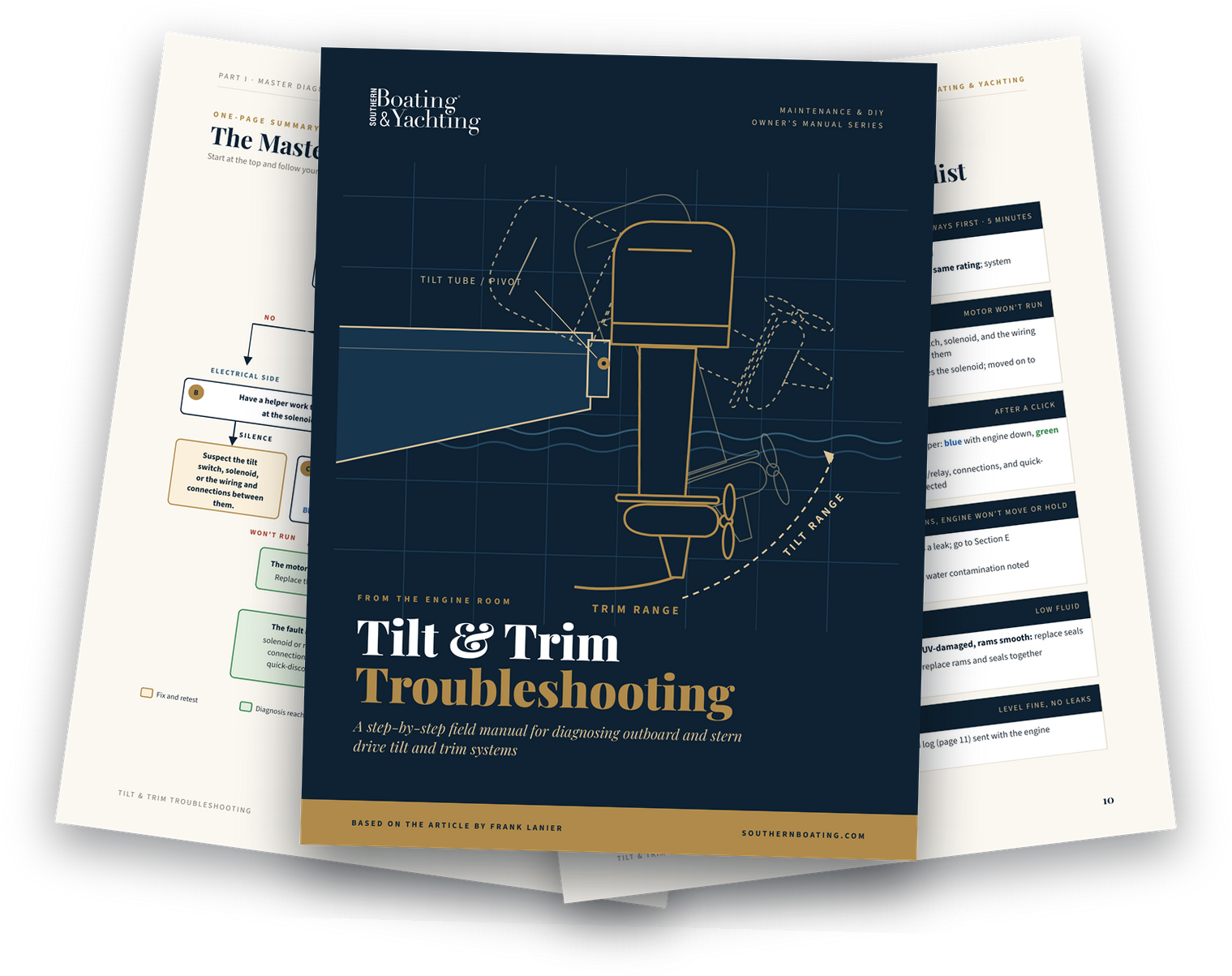
A free 15-page field manual that takes you from a dead trim switch to a diagnosis — fuse, solenoid, motor, or hydraulics — before you pay for a shop hour.
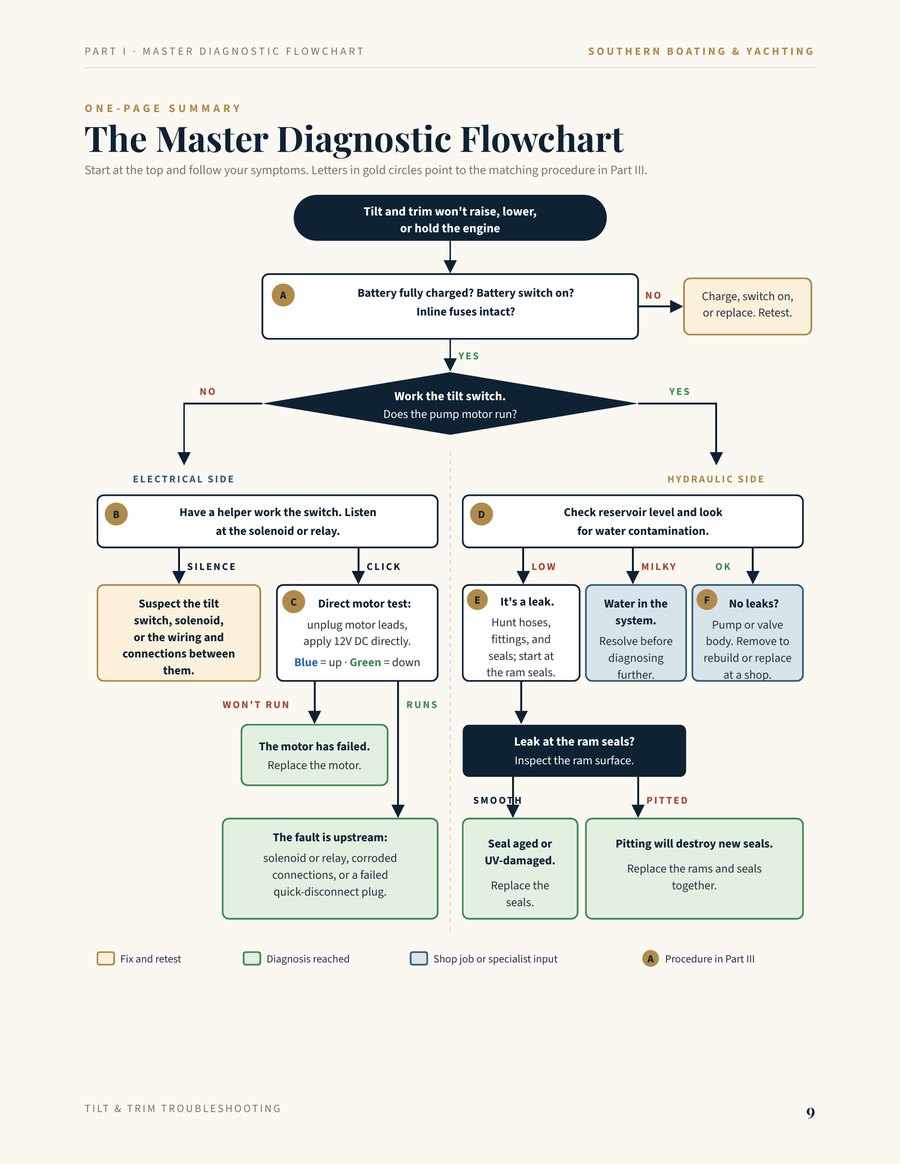
- One-page diagnostic flowchart that sorts electrical from hydraulic faults
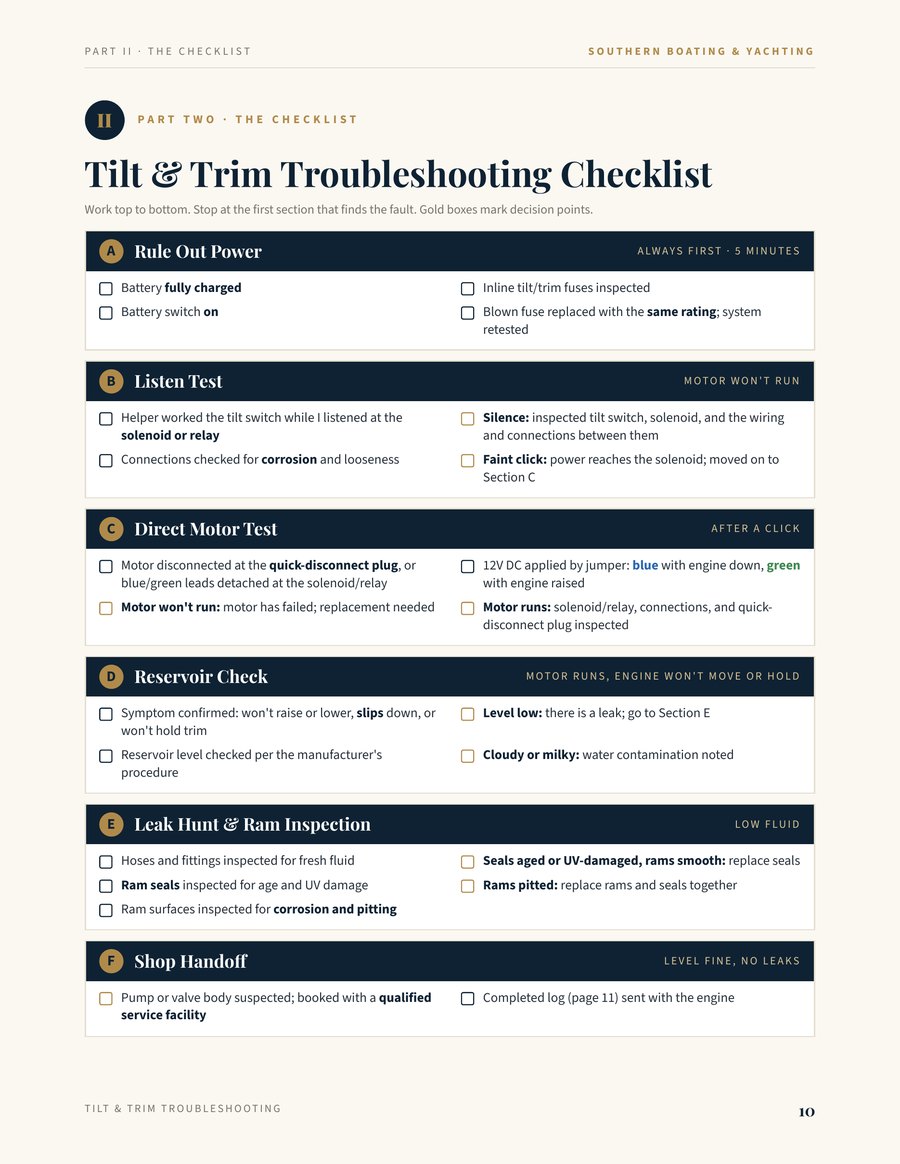
- Printable checklist and troubleshooting log to take to the transom
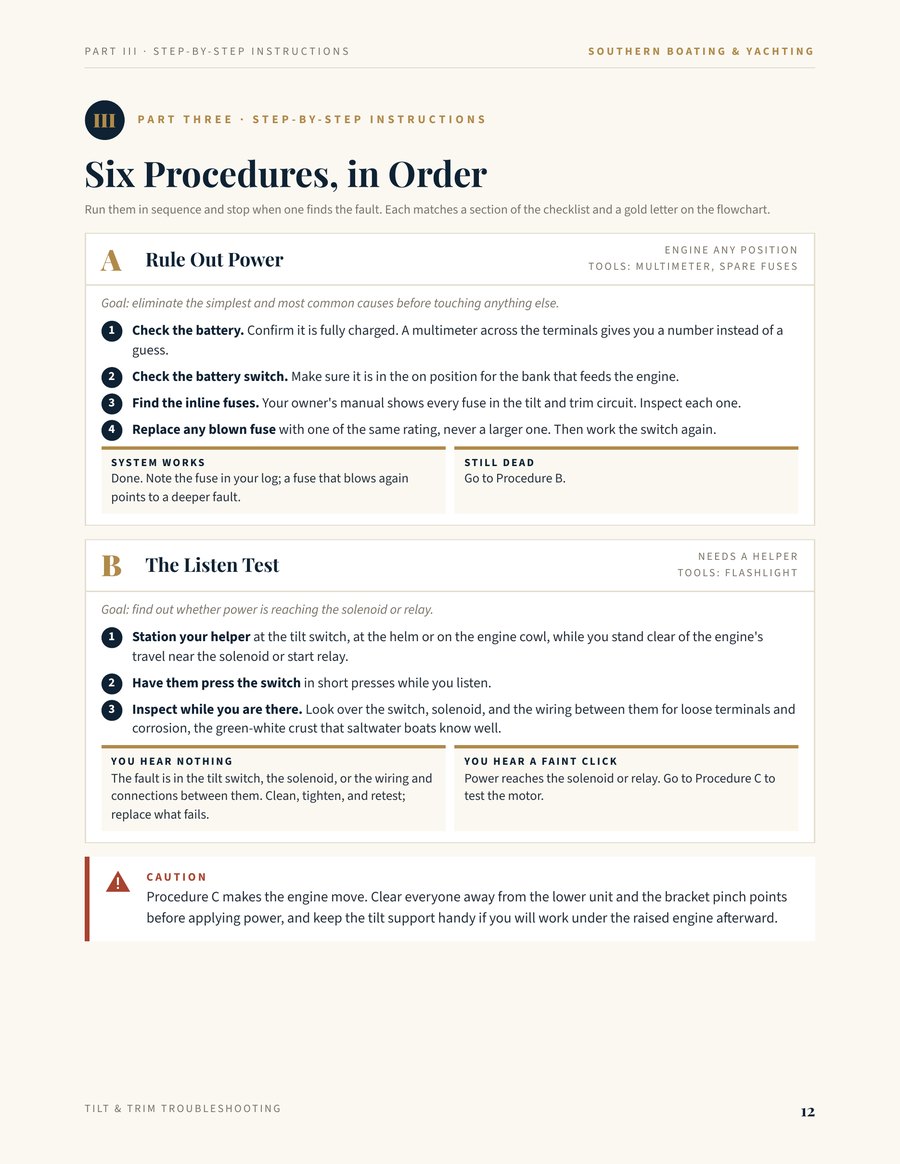
- Six step-by-step procedures, from the fuse to the ram seals
Already on our newsletter? Fill out the form anyway and we’ll send it to you.
15 pagesPrintable, letter size
6 proceduresLettered A through F
Outboards + stern drivesElectric/hydraulic systems
Since 1972Southern Boating & Yachting
What’s Inside
Read it once. Work it at the transom.
I
The Article + Flowchart
Frank Lanier’s guide to how power tilt and trim works and why the diagnostic order matters, condensed into a one-page master flowchart.
II
The Checklist + Log
Print two pages, tick off each check, and record what you find. A completed log saves a technician time and saves you labor charges.
III
Six Procedures
Exact steps for each test and what each result means, from ruling out power to the point where a qualified service facility takes over.
Start Here
The five-minute check before any tilt and trim repair
Work from the cheapest, most likely cause toward the most expensive one. Many tilt and trim failures trace back to a weak battery, a blown fuse, or a corroded connection, so rule those out before you condemn a motor or pull a pump.
- Check the battery. Confirm it is fully charged. A multimeter across the terminals gives you a number instead of a guess.
- Check the battery switch. Make sure it is on for the bank that feeds the engine.
- Inspect the inline fuses. Replace a blown fuse with one of the same rating, never a larger one, and work the switch again.
- Listen at the solenoid or relay. Have a helper work the tilt switch. Silence points to the switch, solenoid, or wiring; a faint click means power reaches the solenoid and the motor is next.
- Read the reservoir. If the motor runs but the engine won’t move or hold, check the fluid. Hydraulic fluid doesn’t evaporate, so a low level means a leak, and cloudy fluid means water contamination.
The manual picks up from there with the direct motor test, the leak hunt, and the ram inspection that tells you whether new seals will hold.
Match the Symptom
Which side of the system is it?
Every power tilt and trim system splits into an electrical side and a hydraulic side. The first job in any diagnosis is deciding which side holds the fault.
SymptomLook first atManual
Nothing happens, no soundBattery, battery switch, fuses, then the tilt switch, solenoid, and wiringA, B
Switch clicks, motor doesn’t runThe motor itself, or the solenoid, relay, connections, and quick-disconnect plugC
Motor runs, engine won’t moveHydraulic side: reservoir level and fluid conditionD, E
Engine slips down or won’t hold trimA leak, most often at the ram seals; inspect the rams for pittingD, E
Fluid level fine, no leaksPump or valve body, a job for a qualified service facilityF
The Source
From our most-read maintenance guide
The manual adapts “Tilt and Trim Troubleshooting” by Frank Lanier, the maintenance guide Southern Boating & Yachting readers return to more than any other, and turns it into a working tool with diagrams, a flowchart, a printable checklist, and step-by-step procedures. It covers electric/hydraulic power tilt and trim on outboards, and most of it applies to stern drives.
Southern Boating & Yachting has covered boats and the people who run them since 1972, and the Engine Room column has carried that know-how in print for decades.
Questions
Tilt and trim repair FAQ
Why does my tilt and trim only click?
A faint click when you work the switch means power is reaching the solenoid or relay. The next step is a direct motor test: unplug the motor leads and apply 12 volts DC to them with a jumper wire. If the motor won’t run, it has failed. If it runs, the fault is upstream in the solenoid or relay, a corroded connection, or the quick-disconnect plug.
Which wire raises the engine, blue or green?
On a reversing 12-volt DC tilt and trim motor, the blue wire raises the engine and the green wire lowers it: “blue sky, green grass.” Older systems may add a black ground wire. Confirm the colors against your engine’s wiring diagram before you apply power.
Why does my outboard slowly trim down on its own?
An engine that slips down from the raised position or won’t hold trim points to the hydraulic side, most often a leak at the ram seals. If the rams are pitted, new seals alone won’t hold, and the rams and seals need to be replaced together.
Does this guide work for stern drives?
It focuses on outboard engines, but most of the diagnostic process applies equally well to stern drive tilt and trim systems. Always follow your engine manufacturer’s manual where its procedures or specifications differ.
Is the manual really free?
Yes. Enter your email and we’ll send the PDF right away, along with the Southern Boating & Yachting newsletter. You can unsubscribe at any time.
Keep it aboard before you need it.
Tilt and trim never fails at a convenient moment. It shows up at the launch ramp, on the sandbar, or when the seas build and you need the bow down.
General guidance only. Tilt and trim designs, wire colors, fuse ratings, and fluid specifications vary by manufacturer. Always consult your engine manufacturer’s manual, and leave any job you aren’t confident in to a qualified marine technician.
1591 E. Atlantic Blvd, 2nd Floor
Pompano Beach, FL 33060
Office: +1 (954) 522-5515
Contact us: info@southernboating.com