
Shine On: Metro Marine's UVC Underwater Lights
Metro Marine’s underwater lights use clear-lens technology to stop marine growth before it starts.
By Doug Thompson

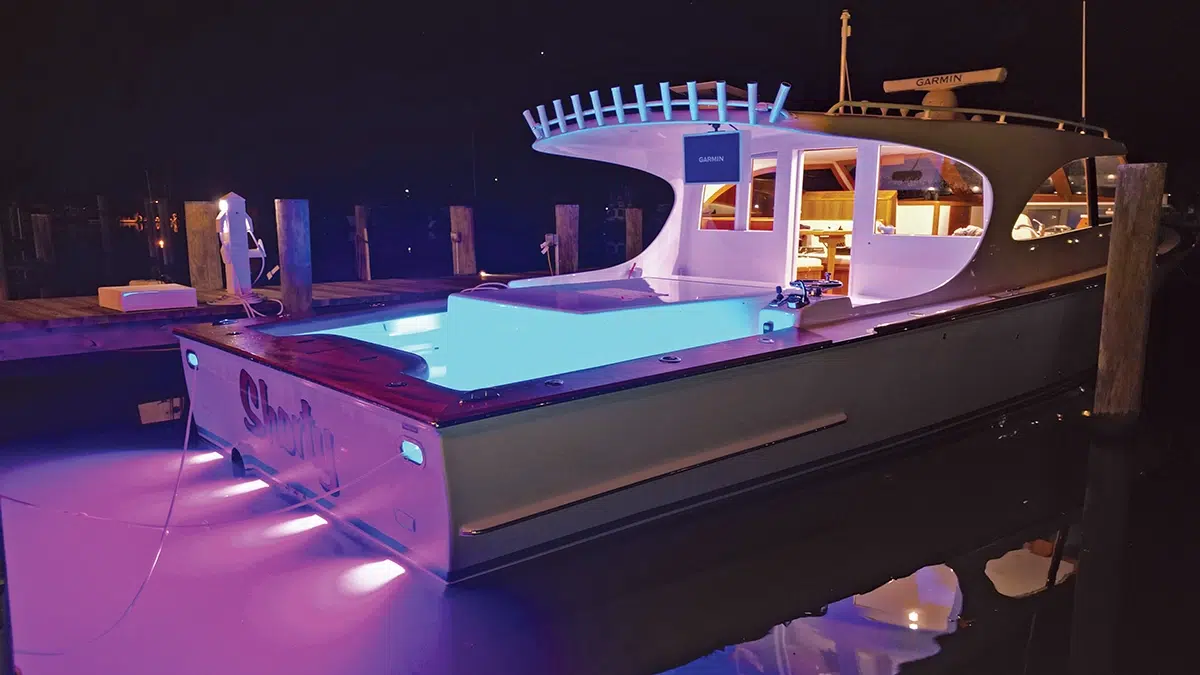
Underwater LED lighting can transform the water around a boat after dark. Whether it paints the water brilliant white, deep blue, or millions of RGBW color combinations, today’s systems are brighter, more efficient, and more reliable than ever.
Why Do Underwater Boat Lights Lose Brightness?
The sea beats down even the best technology. Two factors erode performance: marine growth clouds the lens, and moisture forms inside the fixture and destroys components.
Metro Marine Lighting takes on both challenges with patented technology that keeps marine growth off the lens and a dry-gas assembly method that keeps moisture out of the fixture. The Englewood, New Jersey-based company competes in the premium marine lighting market alongside established manufacturers including Aqualuma, Lumishore, and OceanLED.
Subscribe Here For More Boating Content
“Marine growth doesn’t begin with barnacles or algae; it starts with bacteria,” says Michael Fedele, vice president of Metro Marine. The company began developing its lights in 2014 and brought them to consumers in 2019. “As soon as an underwater fixture is submerged, bacteria begin forming a microscopic biofilm on the lens surface. Once that biofilm develops, algae, barnacles, and other marine organisms can attach themselves, gradually covering the fixture’s lens and reducing light output.”
How UVC Keeps Lenses Clear
Metro Marine developed its patented UVC (ultraviolet C) technology to interrupt that process before it begins. “Our underwater fixtures incorporate dedicated UVC LEDs that periodically energize the lens with a carefully controlled duty cycle of ultraviolet light,” Fedele explains. “Rather than trying to remove marine growth after it has formed, the UVC light prevents the biofilm from becoming established. Without that initial layer of biofilm, larger marine organisms have nothing to adhere to, allowing the lens to remain clear with minimal to no maintenance.”
The company tested the technology extensively in the nutrient-rich waters of Long Island Sound and the warm waters of South Florida to verify it in very different environments. After years of testing and development, Metro Marine patented its use of UVC for underwater lighting and other underwater applications.
“A clean lens allows the fixture to maintain its designed light output and beam pattern over time,” Fedele says. “Instead of losing brightness as marine growth accumulates, the light continues to perform as intended. That translates into lower maintenance costs and more time enjoying the boat.”
Dry-Gas Assembly vs. Condensation
Clear lenses matter, but so do the components behind them. Moisture inside the fixture is the enemy, and that’s where dry-gas assembly comes in.
Metro Marine assembles each fixture inside a Class 1000 clean room, then uses a vacuum chamber to remove moisture-laden air and replace it with highly refined dry inert gas before final sealing. With no trapped moisture, condensation can’t form. That protects electronics and internal metal surfaces from corrosion, extends fixture life, and eliminates the fogging and light distortion that can plague conventional underwater fixtures.
Also Read
44 Boat Debuts to See at the Fort Lauderdale International Boat Show 2026
FLIBS First Look: Get a sneak peek at 44 boats making their first appearance at the Fort Lauderdale International Boat...
How Many Underwater Lights Does a Boat Need?
Most recreational boats use two to six underwater lights, while larger cruising yachts and sportfishing boats may install six to 10 or more, depending on hull size, beam, and the desired effect.
Installation cost depends on hull construction, accessibility, and whether the project is new or a retrofit. Professional installation ranges from approximately $2,000 to more than $10,000, excluding the cost of the lighting system itself.
RGBW Color and Helm Control
Rather than treating white light as a separate mode, Metro Marine’s Dynamic Full Spectrum RGBW technology lets all four channels, red, green, blue, and white, work together for richer colors, more natural whites, and smoother transitions between scenes.
Also Read:
Marlow 70E Review: A Family Yacht With a Story
Purpose Perfected: Aboard a Marlow 70E Built Around Family Built around family, refined through experience, and finished in...
The new MM-CC-V1 Control Center gives captains command of underwater and above-water lighting from a single interface. Garmin approved it for the OneHelm platform, and it carries NMEA 2000 certification.
Owners can buy Metro Marine products through a growing network of authorized dealers, marine electronics installers, and boatbuilders. Customers who contact Metro Marine directly are matched with the dealer or installer best suited to their location and project.