
By Doug Thompson
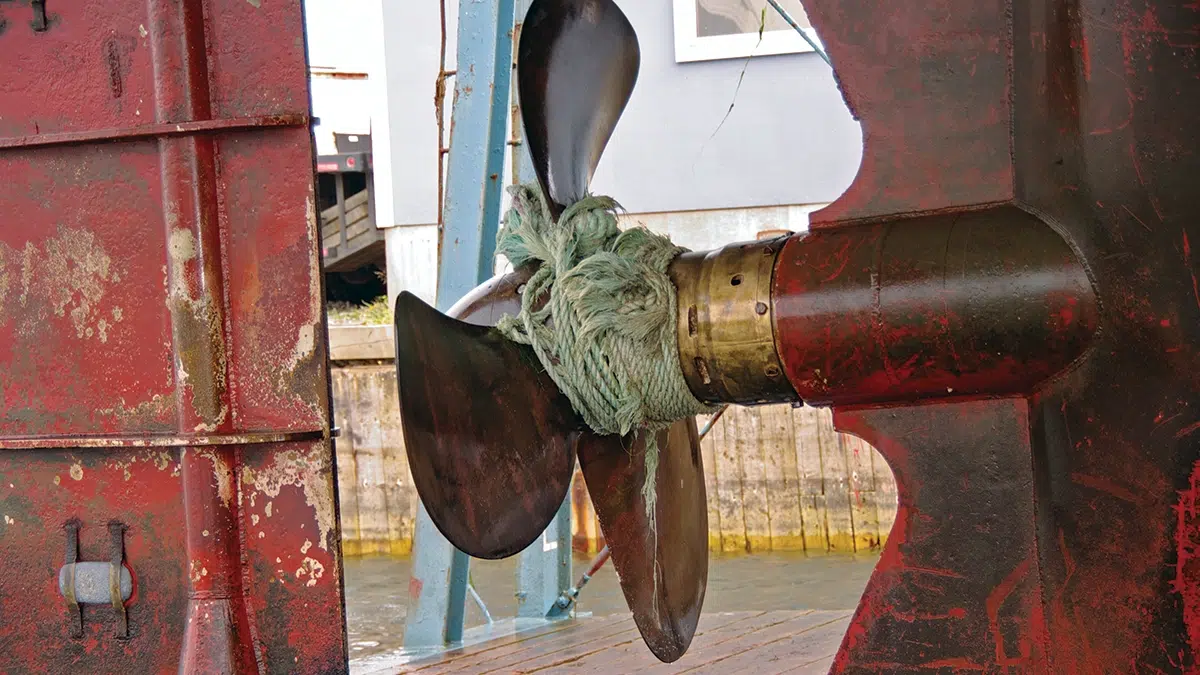
A prop shaft line cutter does one job, and it does that job in the half second that decides whether your afternoon continues or ends on the hook waiting for a tow. Rope, monofilament, and discarded netting find running gear. When that material wraps a propeller shaft, the result runs anywhere from a soft loss of performance to complete propulsion failure.
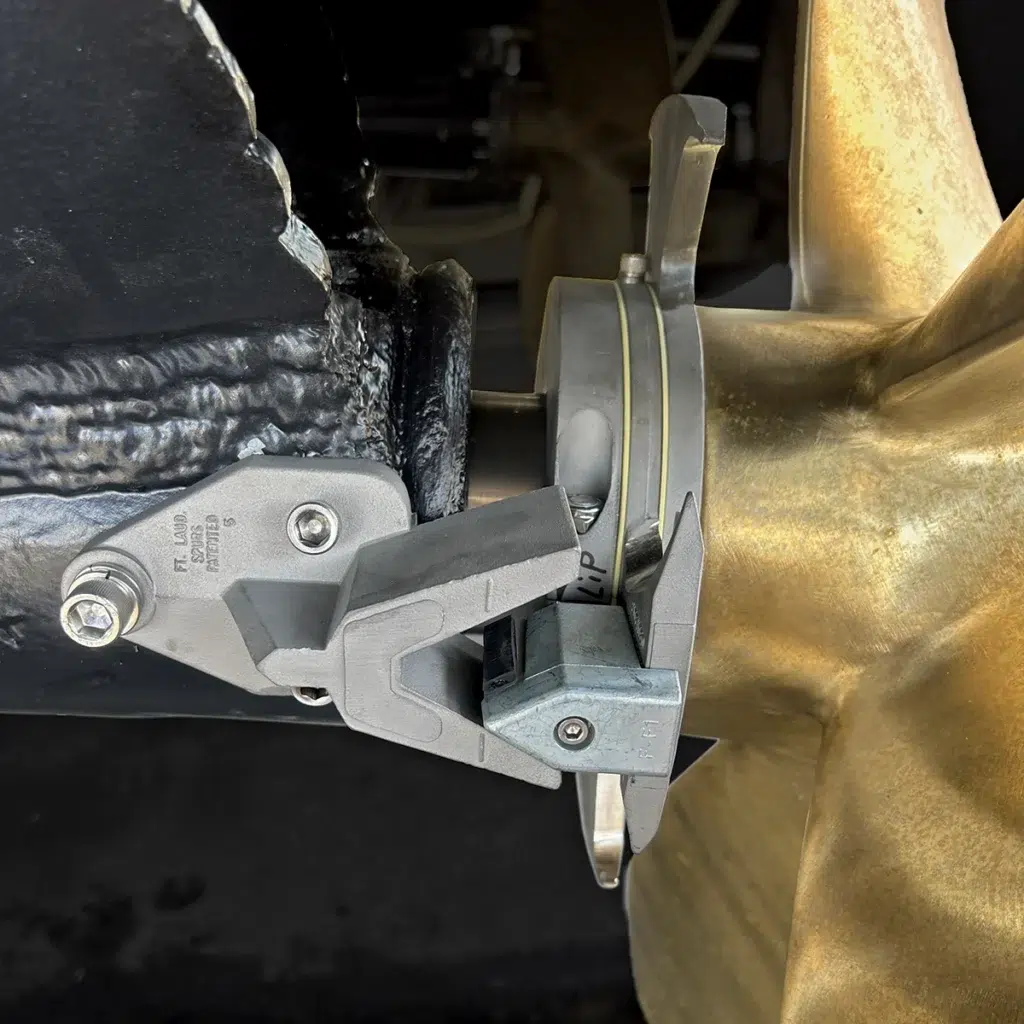
The Spurs Line and Net Cutter System attacks the problem at the point of contact, slicing debris before it draws tight around the shaft and running gear. Owners of inboard cruisers stand to gain the most, and the math on installation works out simpler than most expect.

What Happens When Line Wraps a Prop Shaft
Picture a conventional 50-foot cruiser with single or twin engines turning inboard drive shafts. Let rope or fishing gear catch a shaft on that boat and severe stress transfers straight into the shaft, the bearings, the seals, and the transmission components behind them.
“We not only prevent propellers from becoming entangled, but we also help protect shafts from bending,” says Pablo Sosa, co-owner with Chris Jones of Spurs Marine in Fort Lauderdale, Florida. “Our net cutter also prevents transmissions from damage and engines from overheating or even failing completely. Just as importantly, we help prevent vacations from turning into nightmares.”
Subscribe Here For More Boating Content
Spurs counts thousands of recreational and commercial vessels among its clients, along with the U.S. Navy, the U.S. Coast Guard, and the Canadian Navy.
Time works against every hull in the water. “I always explain to potential customers that nothing can stop a boat engine designed to rotate freely at high rpm faster than a rope or net can wrap around a propeller,” Sosa says. “Also, the ocean moves not only water but debris across hundreds of thousands of miles with no time limits. If you haven’t experienced an entanglement yet, the chances increase every year.”
The Real Risk Is Not the Repair Bill
Without a cutter, clearing a fouled shaft usually sends somebody over the side with a knife. That is the moment a mechanical problem turns into a safety problem.
“If a large wave hits the boat while someone is underneath, the inertia and movement of the vessel can cause serious injury or even death,” Sosa says. “Even experienced divers do not like diving under boats near the hull and propeller in rough waters. Unfortunately, entanglements don’t always happen in calm or warm conditions.”
A boat that loses its propeller goes adrift, and it loses maneuverability at exactly the moment the captain needs vessel control most. From there the hull drifts toward rocks, shipping traffic, or shallow water.
How a Prop Shaft Line Cutter Works
Spurs uses a scissor-style cutting approach. The design directs incoming material into a pair of blades — one rotating, one stationary — and cuts the debris before it wraps tight around the shaft. The system works in forward and in reverse.
Placement carries as much weight as the cut itself. “The cutter has to match not just your shaft, but it has to be very close to the propeller hub,” Sosa notes. “It’s the propeller that gets entangled and brings the line down to the hub itself.”
The hardware backs the concept. Spurs machines its cutters from 17-4 PH stainless steel, the alloy family that shows up in aerospace and marine hardware, then triple heat-treats them to 44–46 Rockwell hardness — significantly harder than ordinary steel.
Also Read
The Hanover 327: The Most Interesting 32′ Cabin Cruiser of 2027
https://www.youtube.com/watch?v=-Lsl2rmlwGM Watch The Full Hanover 327 Walkthrough Here Hanover Yachts is a name you might not instantly be familiar with,...
Which Boats Can Run One?
Spurs builds the system for inboard engines with shaft-driven propellers. Outboards, sterndrives, and pod-drive systems fall outside that description and rarely make good Spurs candidates.
That puts the sweet spot squarely on the conventional inboard cruiser and sportfish — the boats that run offshore, cross busy inlets, and spend long days in water where traps and nets live.
What Installation Involves
A qualified marine service professional handles the work, and the job stays simple in the right hands. The yard takes measurements while the boat sits hauled out, or sends a diver down to take them in the water. Spurs then builds the two-part cutter to those specs.
The installation itself takes about an hour. Performance barely registers the addition: Sosa puts the loss of efficiency at less than 1 percent, based on extensive performance testing by current customers.
Add the measurement step to your next haul-out list and the installation costs you almost nothing in downtime.
What Does a Prop Shaft Line Cutter Cost?
For a 2-inch drive shaft — the most common setup — the Spurs system runs $700 to $1,200, depending on the size of the shaft and any extensive custom work. Spurs accommodates shafts up to 10 inches.
Annual maintenance stays light. Change out the sacrificial anode that protects the cutter from galvanic corrosion, and change the bearings every two years.
Also Read
The Hanover 327: The Most Interesting 32′ Cabin Cruiser of 2027
https://www.youtube.com/watch?v=-Lsl2rmlwGM Watch The Full Hanover 327 Walkthrough Here Hanover Yachts is a name you might not instantly be familiar with,...
What to Settle Before You Order
Four details decide the build, and a service manager can confirm all four in a single visit. Have them in hand before you call:
- Drive shaft diameter. Two inches covers most boats and sets the $700 to $1,200 range; Spurs works up to 10 inches.
- Hub clearance. The cutter has to sit very close to the propeller hub, so the yard measures that gap rather than estimating it.
- How you get the measurements. A scheduled haul-out is the cheap path. A diver works if the boat stays in the water.
- Your service interval. Budget a sacrificial anode every year and bearings every two.
Why Cruisers Should Care
Underwater hazards come with the territory. Dodging buoys and lobster traps in crowded waterways falls to the captain behind the wheel, and running that gauntlet is familiar work to every boater. The submerged lines and nets you cannot see do the most damage, and they do it by wrapping the prop shaft while you hold course at cruise.
“It’s difficult to back off the throttle fast enough when there’s a problem,” Sosa says. “Once you understand the line-cutting system, it’s almost a no-brainer because of how expensive it could be if your engine locks up due to a really bad tangle.”
For more from the engine room and the boatyard, subscribe to the Southern Boating & Yachting newsletter — then explore the digital magazine for the full run of maintenance coverage.