Forward-looking sonar transducers provide a look ahead to spot reefs, shoals, and underwater hazards in real time, making it the best sonar for shallow water boating. In other words, this is how to avoid running aground in the Bahamas.
By Doug Thompson
Keen eyesight and up-to-date charts are a must for boaters operating in shallow, coral-laden waters in destinations such as the Bahamas, Florida Keys, and remote island anchorages. But wouldn’t it be nice to use technology to “see” what lies underwater just ahead of your bow?
That’s where forward-looking sonar helps when boating in the Bahamas, Florida Keys, or remote island anchorages. Here’s how modern systems from Garmin and Simrad are changing the way cruisers explore unfamiliar waters.
Subscribe Here For More Boating Content
How Forward-Looking Sonar Works
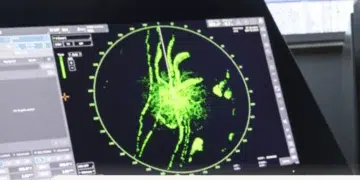
While regular sonar scans straight down, forward-looking sonar gives you a picture of what’s ahead of the boat in real time. That provides the captain the needed information to avoid reefs and underwater hazards before they become dangerous.
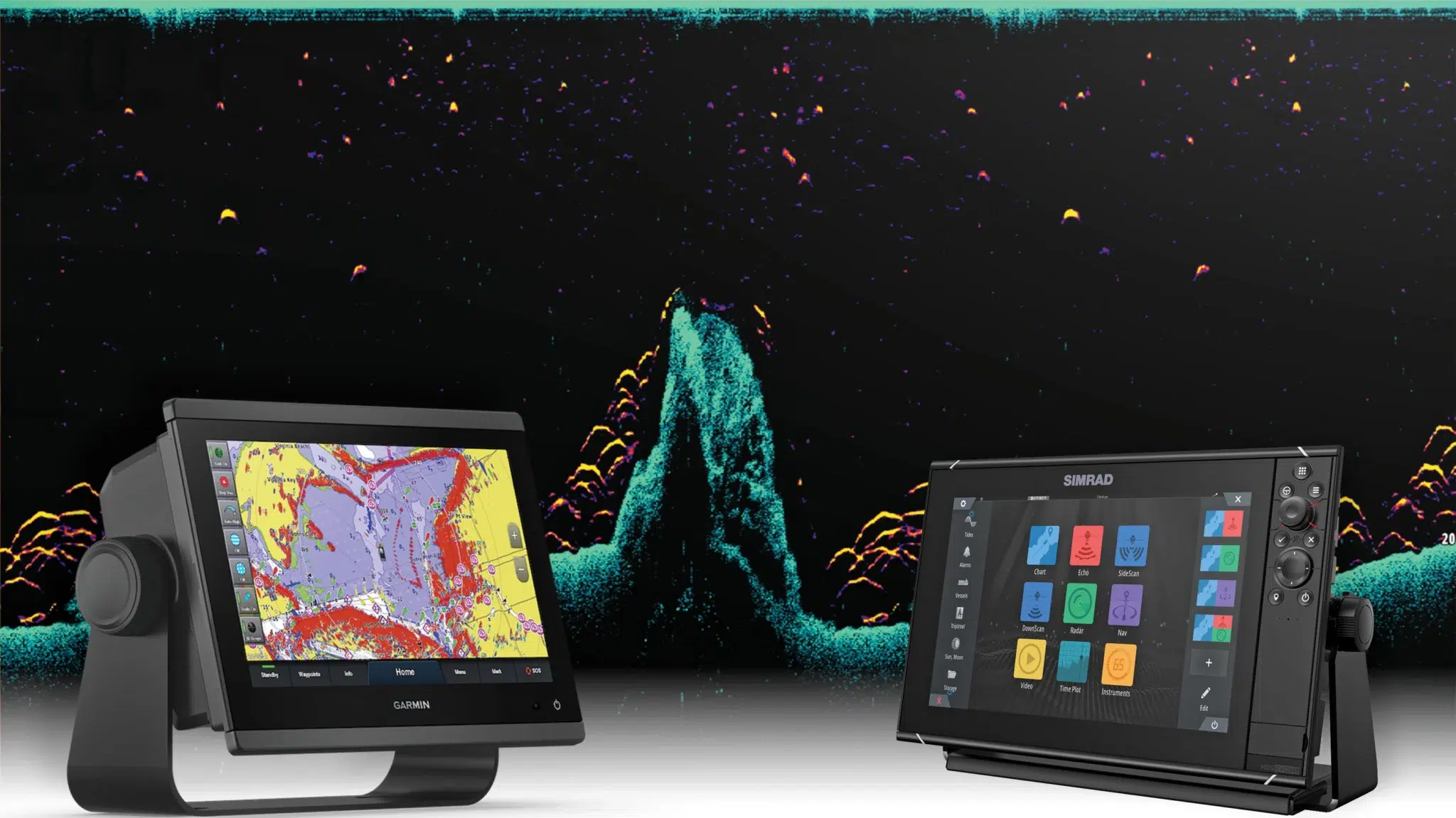
Leading marine electronics manufacturers Garmin and Simrad offer forward-looking sonar transducers, installed within the bow of your vessel, and then display the information on your chartplotter or multifunction display.
Garmin and Simrad Sonar Systems Compared
The Garmin Panoptix PS51-TH FrontVü sonar retails for $1,599 and offers phased-array multibeam technology. The narrow beam focuses on what’s directly in front of the hull, reducing clutter from the sides for a clear picture of the underwater terrain. A motion sensor helps stabilize the sonar imagery in rough water, so what you see on the MFD is accurate when the boat is pitching or rolling.
Simrad’s ForwardScan sonar retails for $820. The ForwardScan data can overlay directly on your navigational chart’s heading line. Color-coded depth segments showing deep, medium, and shallow water make it easy to correlate what the sonar sees ahead with the chartplotter’s route, helping you make smarter steering decisions.
Both systems can view up to 300 feet ahead of the vessel in optimum conditions.
Also Read
Ferretti 940 Review: A Pocket Megayacht With Italian Luxury and Practical Comfort
The Ferretti 940 represents a pleasing mix of Italian style and onboard comfort. By Kevin Koenig Whenever I go to...
Why Forward-Looking Sonar Matters in the Bahamas and Florida Keys
“Enabling the ForwardScan chart overlay will provide a visual alert on the chart cone (in green, amber, or red) for increased situational awareness as you navigate and approach a restricted area,” says Matt Eeles, product director of electronic solutions for Navico Group. “This is useful for a quick reference if the cone turns red on the outer limit when it detects an object within the alarm limits.”
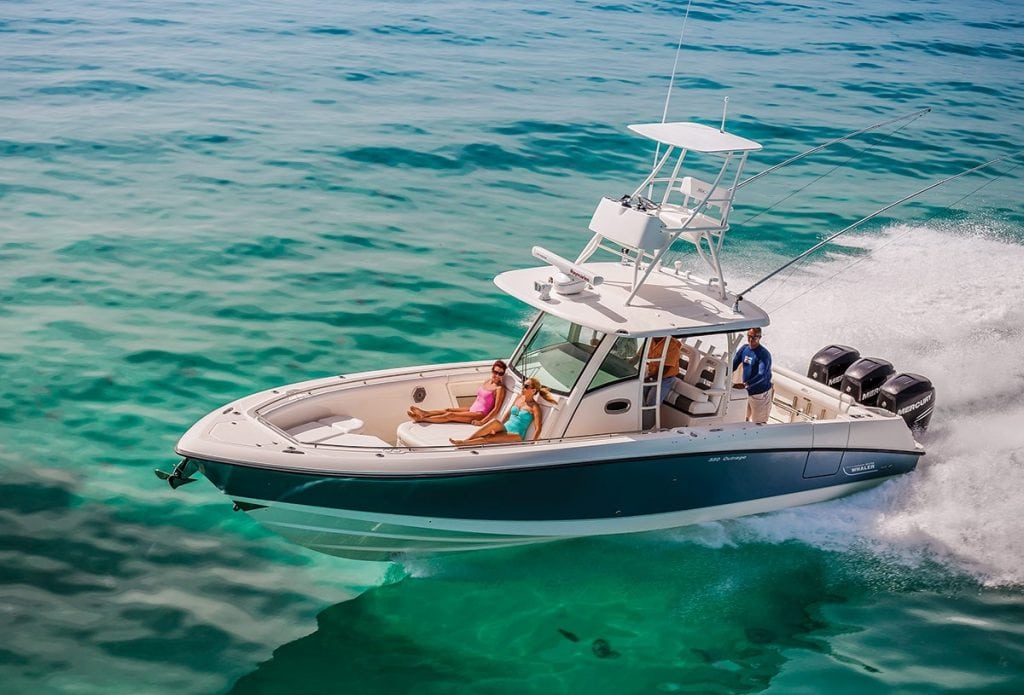
For example, say a 35-foot center-console boat is piloted into a narrow cut in the Bahamas. Even at slow maneuvering speeds of 5 to 10 knots, the boat may cover 50 to 150 feet in seconds. The charts you have may be inaccurate and outdated due to sand movement, hurricane damage, or coral growth.
Real-Time Protection from Reefs, Shoals, and Coral Heads
Forward-looking sonar provides a live view of the seabed ahead, allowing the operator to see shoals, ledges, or rising coral before the boat reaches them, so they can reduce throttle, trim up the engines, or change course safely.
In addition, the side view is good for determining distances to objects, which cannot easily be determined from the chart overlay. It also shows calculated depth and alarm levels.
Also Read:
Tilt and Trim Troubleshooting
When your outboard’s tilt and trim system fails, you feel it immediately. You can’t optimize your running angle...
Using Sonar While Anchoring in Remote Waters
“It can also be useful to see the history so you can understand the gradient if it’s getting deeper or shallower, or if you passed over a shallow area that may be of a concern,” Eeles says. “And when anchoring, it can be useful to do a 360-degree scan before dropping the anchor, looking for close coral bommies, which you could end up wrapping your anchor chain around as you swing.”
3 Situations Where Forward-Looking Sonar Can Save Your Day
- Entering an unfamiliar Bahamas cut.
- Anchoring near coral heads.
- Navigating after storms when channels may have shifted.
Understanding Installation and Ownership Costs
In addition to the transducer, there are other costs to factor in if you are considering adding forward-looking sonar. These sonar systems require a chartplotter or multifunction display, if not already installed, which costs $800 and up. It’s likely best to hire a marine service professional to install the transducer and through-hull fitting, from $500, and then add another $200 to $600 for hauling out the boat.
Is Forward-Looking Sonar Worth the Investment?
The costs are a worthy investment because adding a feature like forward-looking sonar can make you a better boater and open up more water to explore. Instead of proceeding blindly at idle speed in a new area, the captain can safely maintain an efficient maneuvering speed while continuously monitoring underwater hazards. That alone reduces stress and increases confidence when cruising in remote island environments.
Finally, while the transducer is exposed and subject to damage, it can be replaced easily. The trade-offs—safety and peace of mind—are worth it if you are exploring unfamiliar seas.
Forward-Looking Sonar FAQ
What is the difference between traditional sonar and forward-looking sonar?
Traditional sonar measures depth directly beneath the boat, while forward-looking sonar scans underwater terrain ahead of the vessel.
Can forward-looking sonar detect reefs and coral heads?
Yes. Forward-looking sonar can identify reefs, shoals, coral formations, and other underwater hazards in real time, helping boaters avoid groundings.
How far ahead can forward-looking sonar see?
Systems such as Garmin Panoptix FrontVü and Simrad ForwardScan can display underwater features up to approximately 300 feet ahead in optimal conditions.
Is forward-looking sonar worth installing?
For cruisers who regularly navigate shallow or unfamiliar waters, forward-looking sonar can improve safety, reduce stress, and increase confidence when exploring remote destinations.