
Summary
Water, condensation, and airborne bacteria can contaminate diesel fuel tanks, leading to clogged filters, poor engine performance, and costly repairs. This article explains how fuel-polishing systems work by continuously circulating diesel fuel to remove water, sediment, and microbial growth before they become a problem. It also explores why modern ultra-low-sulfur diesel makes fuel contamination a greater concern, compares portable and built-in fuel-polishing systems, and shares expert recommendations on how often boat owners should run a polishing cycle to keep their engines operating reliably.
Why Ultra-Low-Sulfur Diesel Needs Fuel Polishing
A fuel-polishing system removes water and bacteria from a boat’s diesel tank, protecting today’s high-pressure engines from costly fuel contamination.
By Doug Thompson
Diesel and water don’t mix — but water gets into a boat’s fuel tank anyway, through condensation and venting, and it sinks to the bottom. Dust and microscopic bacteria get in too, and together they form a watery breeding ground that can foul an engine.
Fuel polishing solves the problem. The process recirculates fuel to strip out water, sediment, and microbial contamination, and recreational cruisers increasingly treat it as a maintenance essential rather than an optional extra.
Subscribe Here For More Boating Content
What Fuel Polishing Actually Does
Ron Lenz, founder of Fueltec Systems, helped develop today’s leading fuel-polishing techniques. Lenz got involved 26 years ago after his 52-foot Bertram started giving him trouble.
“I was running out of the Jupiter Inlet into the Atlantic Ocean fishing for sailfish,” Lenz says. “My engine was quitting, and I decided to figure out what was causing the problem.”
Lenz contacted the University of Miami and began researching the issue alongside biologists and chemists. They learned water was only part of the story.
“We found out that the black clusters on my fuel filters were actually bacteria,” Lenz says. “The bacteria grows in water, which gets into your fuel tanks through vents or condensation, or maybe the water is just delivered with the fuel.”
Also Read
This Must Be the Place: The Reintroduced Sabre 38 Salon Express
There is a curious thing that happens the moment the lines are cast off. The constant urge to check your...
How Water and Bacteria Get Into a Diesel Tank
The bacteria is airborne and microscopic, so no boat can keep it out entirely. The best defense is to continually remove the water bacteria needs to grow — which is exactly what fuel polishing does. Because many boats sit at the marina for long stretches between trips, fuel polishing ensures an engine gets clean fuel even after months of inactivity.
“I developed a system to remove the water out of the tank on my own boat,” Lenz says. “It worked beautifully, and I got a patent on purifying fuel in 2001 and started building systems. Now we build fuel-polishing systems for diesel applications all over the world, including emergency generators.”
Water is heavier than fuel, so diesel floats on top of it. Once bacteria gets a foothold and nobody removes the water, the bacteria colonizes that water-fuel interface and starts clogging filters.
Also Read:
20 New Power Catamarans You’ll Want to Cruise in 2026
Catamarans are stable, roomy, and love to purr. It it seems like there are a lot of new...
Portable vs. Built-In Fuel-Polishing Systems
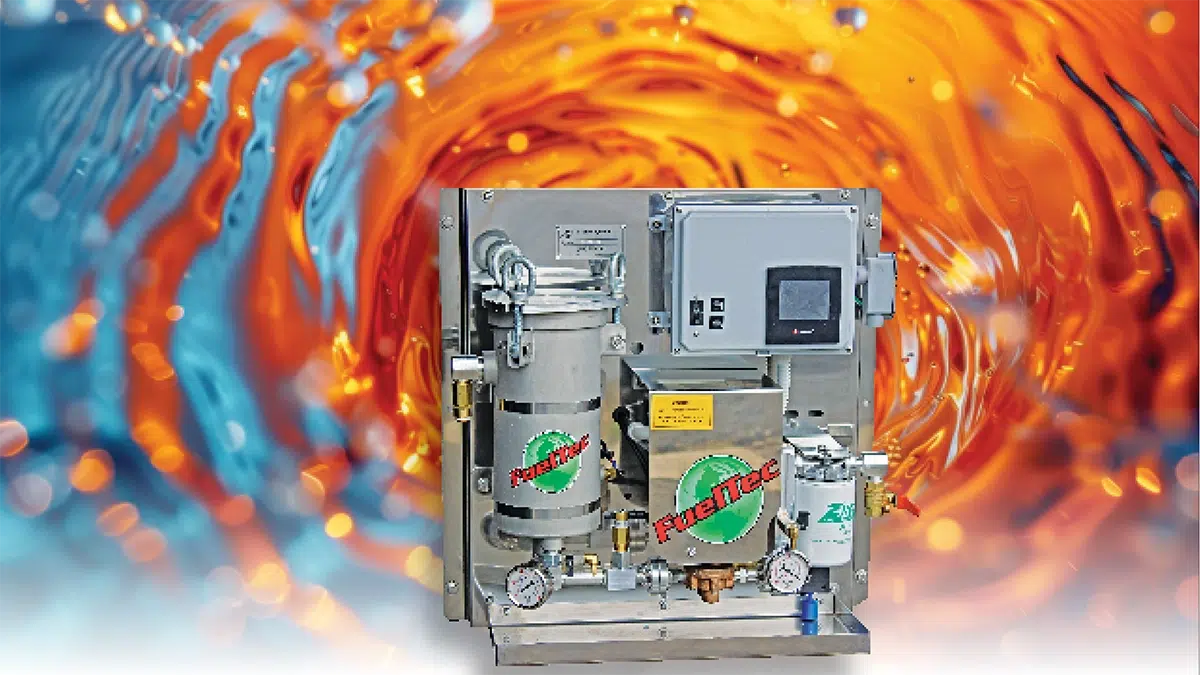
Fuel-polishing systems come in two forms. Portable units, such as Fueltec’s BIO-VAC 270 Fuel Polishing System, let an owner polish fuel dockside. Built-in units, such as Fueltec’s CF5.0 UL-PCB 5GPM with PCB controller, install directly in the engine room and let an owner polish fuel anywhere, anytime.
A fuel-polishing system does not replace a boat’s fuel filters — it’s an independent system that circulates fuel when the engine is off, giving the stored diesel time to clean itself through the filtration process. Fuel conditioners and other additives that enhance that filtration process only help.
Fuel quality also varies in foreign ports, where an owner can’t always verify what’s in the tank before fueling up. Running a polishing cycle before putting new fuel to use removes that guesswork; the primary objective, in every case, is removing water from the tank.
“Most applications need a system that is continually circulating the fuel, maybe not 24/7, but maybe an hour and a half a day or two hours a day,” Lenz says. “That way, if any moisture shows up in that tank, it’ll take it out of there before the bacteria can grow.”
Why Today's Cleaner Diesel Makes This More Urgent
Cleaner-burning modern engines are, ironically, a big reason fuel polishing matters more today than it used to. Older diesel engines ran less efficiently, emitting smoky exhaust and burning high-sulfur fuel.
“Older diesel injection systems only used about half the fuel pressure modern engines do, and older injectors send the fuel through much larger passages,” Lenz says. “If there was a little moisture in the storage tank, the high sulfur content killed most of the filter-clogging bacteria and fungi.”
Today’s ultra-low-sulfur diesel no longer offers that natural protection, so filter-clogging bacteria and fungi grow rapidly wherever moisture sits in a fuel tank. At the same time, modern diesel engines run high-pressure fuel injectors with tiny passages that clog easily with dirty fuel — and water damages them fast.
How Often to Run a Fuel-Polishing System
Experience has taught Lenz the most. His company now supplies fuel-polishing equipment to the Bahamian government, the Colombian Navy, Saudi Arabia, and custom-yacht owners worldwide — proof that the same problem Lenz found in his own Bertram shows up in fuel tanks everywhere diesel engines run.
For most cruisers, that means treating fuel polishing the way Lenz does: a short daily cycle, run consistently, so water never gets the chance to sit long enough for bacteria to take hold.