
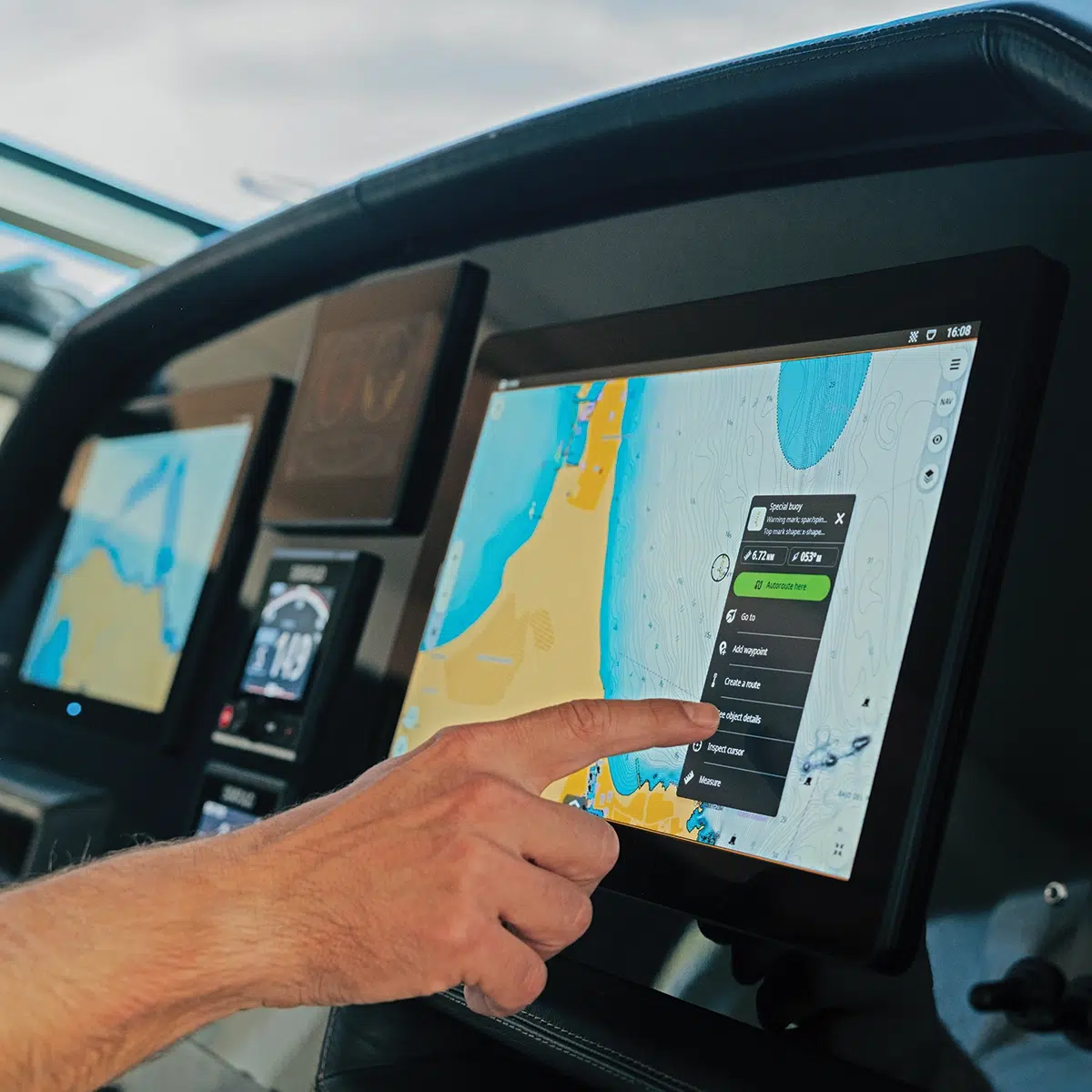
Going Large: Why Bigger MFDs Now Rule the Helm
By Doug Thompson
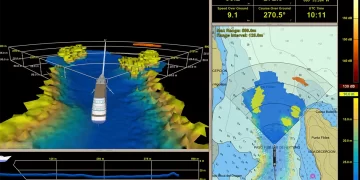
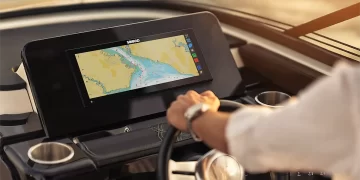
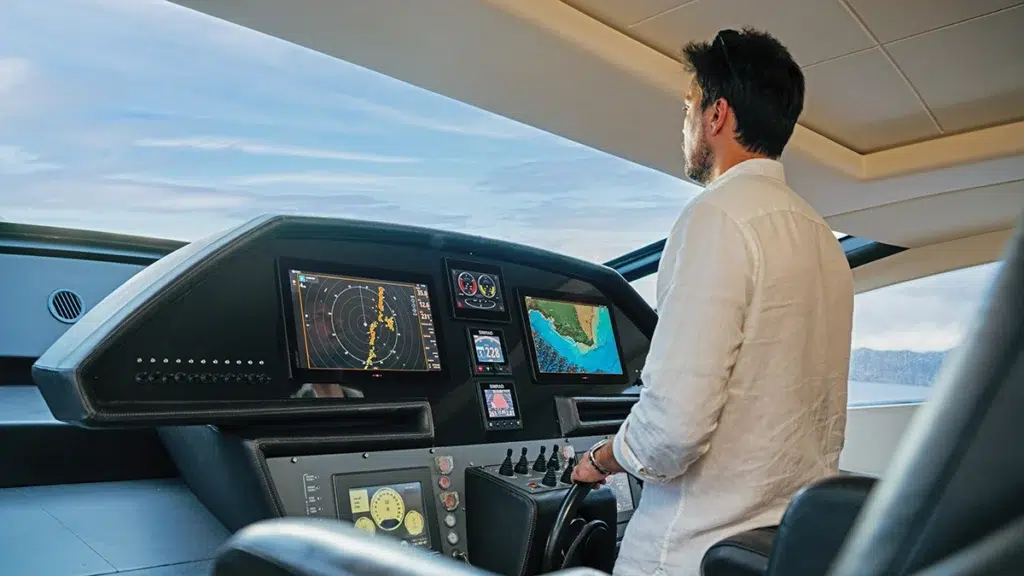
Information is power, and that’s why larger multifunction displays now dominate the dash panels of cruising vessels. A 24-inch MFD lets the captain split the screen into as many as six views, putting engine monitoring, bird’s-eye external cameras, and more within the captain’s sight and control.
For operators who want a single view—say, an external camera aimed directly forward of the bow—a large screen delivers crisp resolution and remarkable detail. That view can improve safety, too, because it makes a small obstruction in the water far easier to spot.
Subscribe Here For More Boating Content
What Does a Larger MFD Do for the Helm?
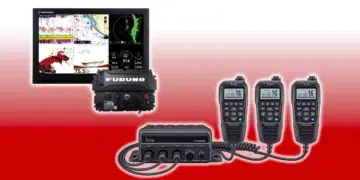
“At Furuno we offer a 24-inch and even a TZTBBX black-box MFD for boat owners who may want a screen larger than 24 inches in their dash,” says Jeff Kauzlaric, Furuno’s advertising and communications manager. “All of Furuno’s MFDs in the TZTXL lineup use the same fast processor and have resolutions of 1920 x 1080 for clear pictures and bright, vibrant colors to ensure you don’t miss any of the fine details. Furuno has also optimized our TZ MAPS cartography for super-fast redraw and a high level of detail.”
Furuno offers 11 different screen setups, from a full single-screen view to six individual screens at once. That adds up to 32 possible screen layouts, and every MFD in the TZTXL lineup includes the feature.
The push toward bigger, simpler displays stretches back decades. Garmin’s 27-inch GPSMAP 9227 Premium, a 4K display, ranks among the largest integrated MFDs available and runs charts, radar, sonar, engine data, and video simultaneously in split-screen mode.
The Glass Bridge Comes of Age
“The glass bridge concept has continued to gain momentum over the past 10-plus years, particularly in larger cruising vessels,” says Adam King, production manager at the Navico Group, which includes Simrad. “Recent evolution has focused on installation improvements. There is integrated/flush-style mounting that has become more common, and newer designs address installer pain points to simplify setup and improve finish quality.”
The user experience improved as well. Owners now compare modern interfaces to automotive systems or high-end smartphones—intuitive and familiar, with a short learning curve. Many Simrad apps carry a button in the bottom-right corner that takes them full screen in a single push.
Owners once considered simple system integration an option. Now they expect it, and the MFD serves as the central command hub for the entire vessel.
Also Read
Jeanneau TH38 Review: An Outboard Power Cat for the Weekend
Jeanneau TH38: What a Difference a Dayboat Makes Jeanneau's latest twin-hull series opens the door for extended fun. By Steve...
How Does an MFD Become the Command Hub?
Simrad built its NSO 4 with integration at its core. The unit supports CZone, Mastervolt, and Lenco Pro Control, along with a wide range of third-party partners, so the captain can control and monitor lighting, power management, audio, stabilization, and collision avoidance from the helm.
“We are certainly getting there quickly,” says Kauzlaric. “As expected, you can control any Furuno ancillary equipment, such as any of our black-box fish finders, AIS, radars, autopilot, satellite compass, and omni Sonars. Furuno also has our Command Center built into each TZTXL. Right now, we work with more than 30 HTML5 partners to allow control of their equipment through our Command Center. This includes control of cameras, digital switching, lighting, water makers, stereos, motion control, batteries, and electrical systems as well as many other items.”
Can You Retrofit a Larger MFD on an Older Boat?
Older vessels benefit from larger MFDs, too. The trick lies in planning the install down to the finest detail, because a retrofit’s complexity depends on the dash layout and the space available.
Enlarging a cutout is simple work, but it may mean repositioning gauges or switches. The installer also needs access behind the panel for proper mounting and a clean, flush finish. On angled dashes in particular, sight lines and helm ergonomics deserve careful thought.
“That said, many owners find the upgrade well worth it,” King says. “A larger MFD can significantly modernize an older vessel, improving both functionality and overall experience. When space allows, most customers have no regrets about going bigger.”
Also Read:
Jeanneau TH38 Review: An Outboard Power Cat for the Weekend
Jeanneau TH38: What a Difference a Dayboat Makes Jeanneau's latest twin-hull series opens the door for extended fun....
Two 13-Inch MFDs or One Large Display?
Another strategy pairs two 13-inch MFDs side by side, which creates nearly the same look without committing to one large unit.
“That certainly works, because it offers you the possibility to create six screens on each 13-inch MFD at the same time,” Kauzlaric notes. “If you have two 13-inch MFDs side by side, that means you could be looking at up to 12 screens at one time.”
How Do You Manage Six Screens at Once?
A captain might expect that many views to crowd the helm, but Furuno solved the problem with a custom two-finger tap. Tap two fingers on any pane of the split screen, and that view jumps straight to full screen.
“Let’s say you’re running your TZT13X in a six-way split and you see something on the radar screen that makes you want to know more,” Kauzlaric says. “Just tap two fingers on the radar screen of the split screen and the radar section will immediately go to full-screen radar. You can then leave the radar at full screen, or you can two-finger tap the screen again to go back to your split-screen view.”